BLACKLEDGER · DAILY INTEL

2026-10-17 · every data pipeline, live · research-only

BLACKLEDGER Watchlist
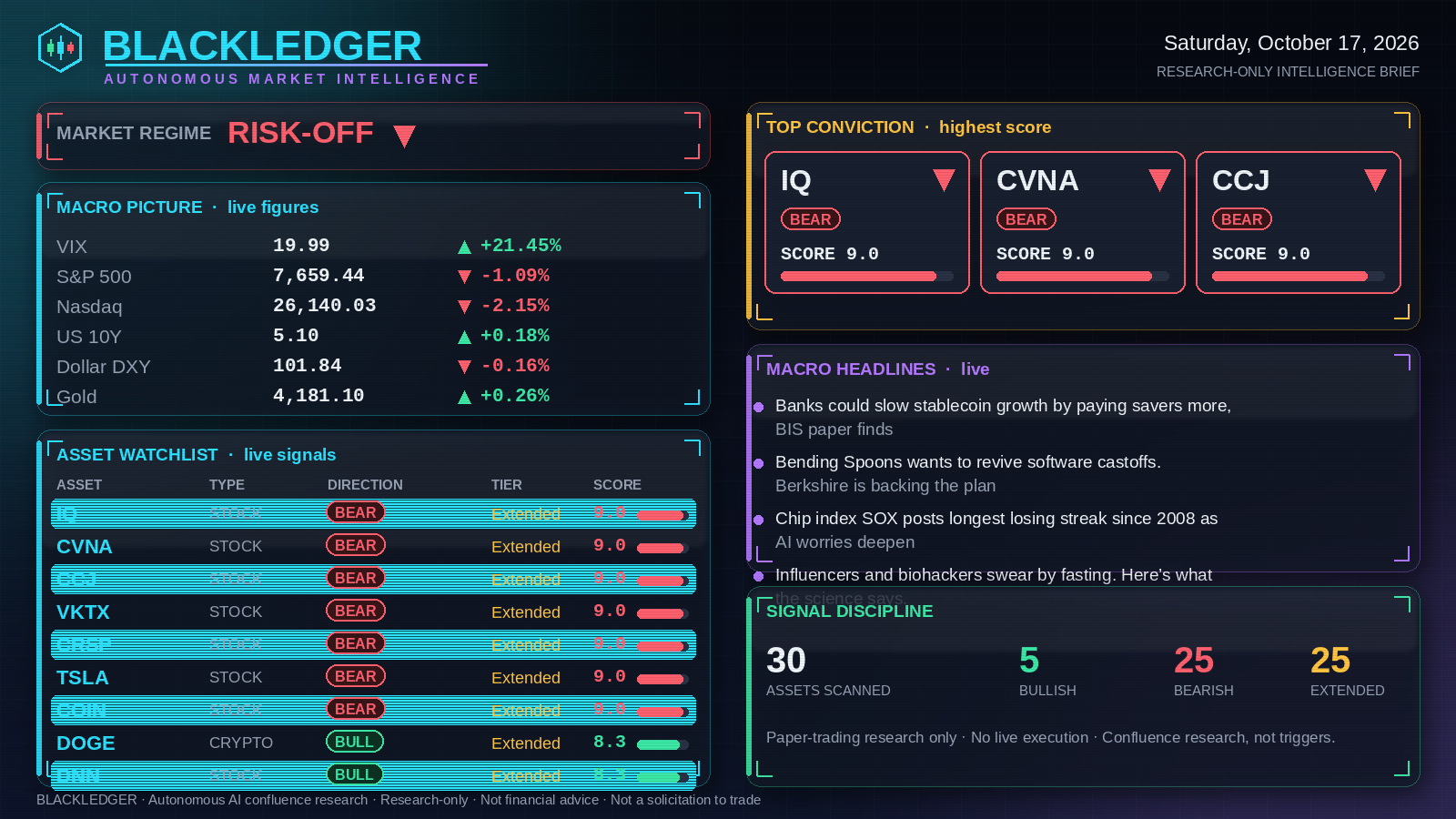
RISK READ SCORE 50/100

BLACKLEDGER Watchlist

BLACKLEDGER Watchlist Layer: RISK_READ at 50 / 100

Our 2026-10-17 quantitative run on the BLACKLEDGER Watchlist layer reveals a market in structural equilibrium, evidenced by a composite score of 50/100. This neutrality suggests a pivot point where institutional distribution is beginning to weigh against residual momentum. While broader indices appear stable, the underlying signal architecture is surfacing high-conviction bearish divergence across growth-sensitive names, marking a transition from accumulation to tactical de-risking.

Signal Breakdown:

1. TSLA

Signal: High-Conviction Bearish Divergence

Read: With a score of 9.0, the signal indicates an exhaustion of the retail-driven bid and a structural shift in institutional flows. We anticipate volatility expansion as price action fails to sustain premium valuations against tightening liquidity.

2. CVNA

Signal: Momentum Reversal Alert

Read: Carvana shows a 9.0 bearish score, suggesting the recent short-covering rally has reached a point of diminishing returns. The data implies institutional desks are positioning for an unwind as squeeze dynamics lose fundamental support.

3. CCJ

Signal: Sector Rotation Exhaustion

Read: Cameco is flashing a 9.0 bearish signal, indicating the uranium-specific trade is overextended. The read suggests tactical rotation out of the name as profit-taking becomes the dominant structural flow.

The Strategic Implication: A risk_read regime at 50/100 signifies a market that is fragmented at the constituent level. For institutional desks, alpha will be generated through selective shorting of overextended assets rather than broad index exposure. This read remains valid while the composite score stays anchored near the median; a move above 65 would invalidate the bearish lean by signaling fresh risk-on liquidity, while a drop below 40 would confirm systemic deleveraging.

We don't trade the noise. We trade the structure.

The Truth Behind The Trade.
Sovereign liquidity
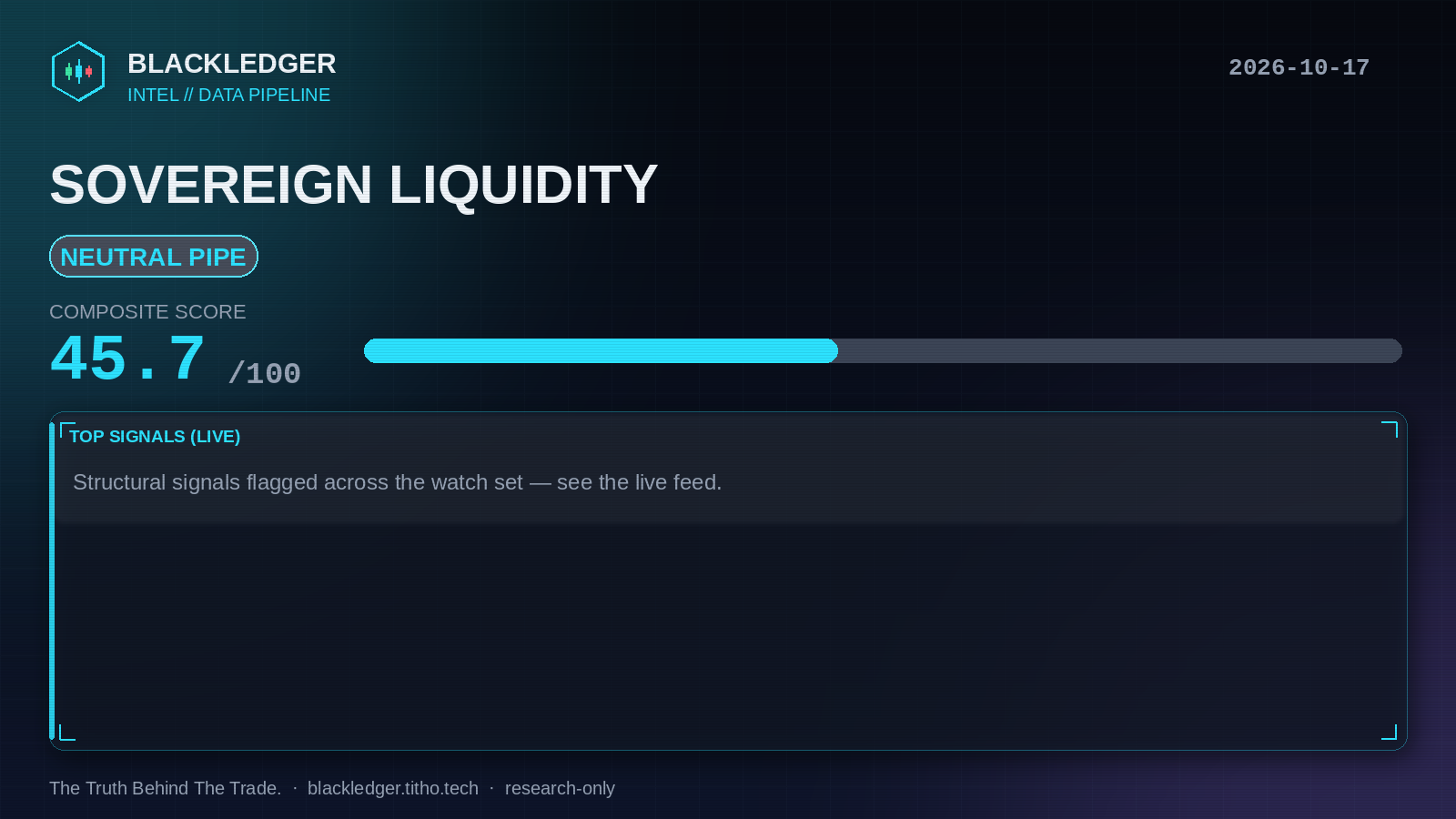
NEUTRAL PIPE SCORE 45.7/100

Sovereign liquidity

Sovereign liquidity Layer: NEUTRAL_PIPE at 45.7 / 100

Our 2026-10-17 quantitative run on the Sovereign liquidity layer prints a neutral pipe regime, registering a composite 45.7/100. The signal set below frames how institutional positioning is leaning today.

Signal Breakdown:

1. Sovereign liquidity composite

• Signal: Neutral Pipe

• Read: composite 45.7/100 — consistent with a neutral pipe regime at 45.7/100; watch for a shift as positioning resolves.

2. Sovereign liquidity composite

• Signal: Neutral Pipe

• Read: composite 45.7/100 — consistent with a neutral pipe regime at 45.7/100; watch for a shift as positioning resolves.

3. Sovereign liquidity composite

• Signal: Neutral Pipe

• Read: composite 45.7/100 — consistent with a neutral pipe regime at 45.7/100; watch for a shift as positioning resolves.

The Strategic Implication:

A neutral pipe read at 45.7/100 sets the structural bias. Position to it, and re-underwrite if the 45.7/100 composite or the neutral pipe regime breaks.

We don't trade the noise. We trade the structure.

The Truth Behind The Trade.
Credit and real-estate
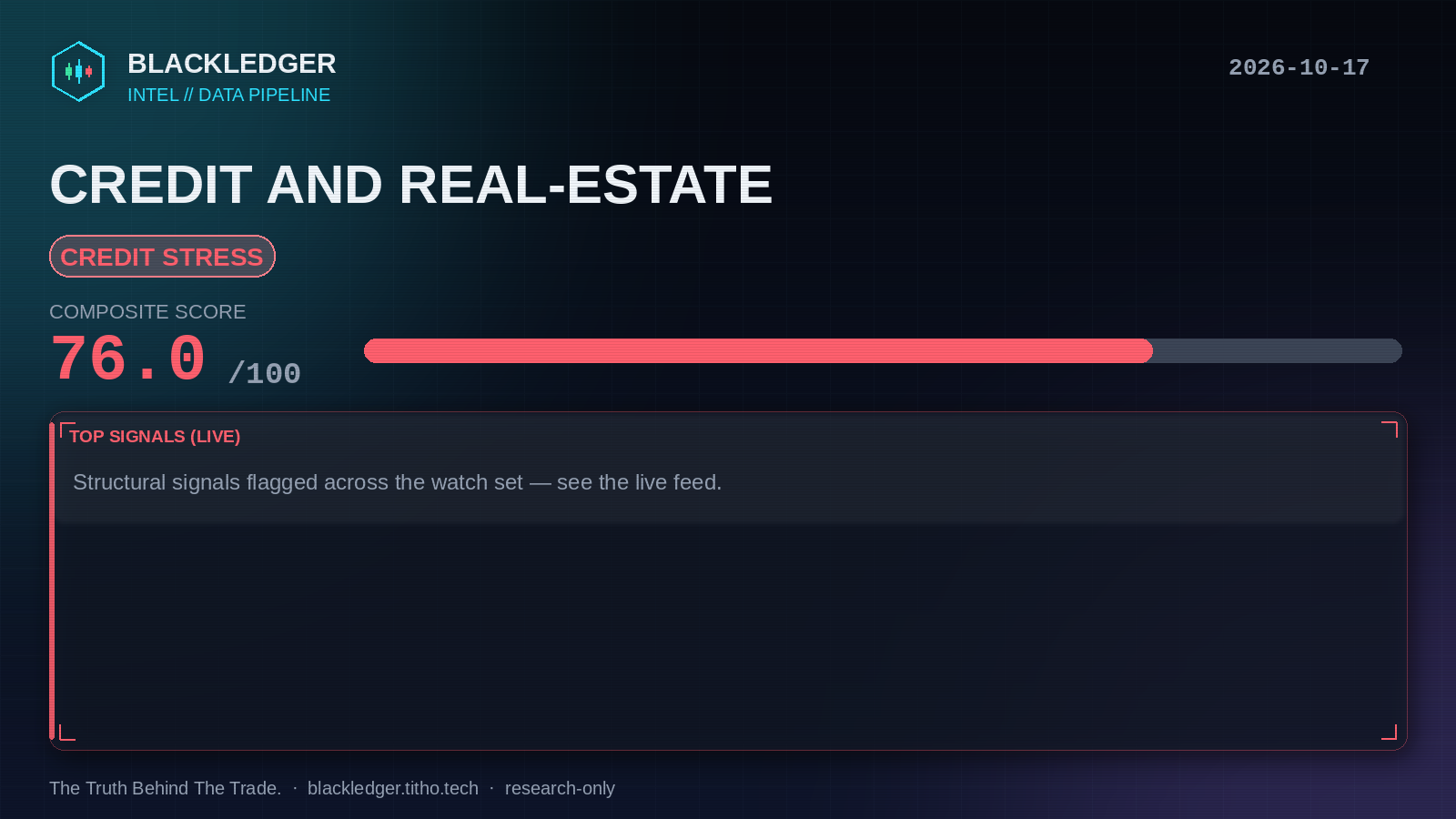
CREDIT STRESS SCORE 76.0/100

Credit and real-estate

Credit and real-estate Layer: CREDIT_STRESS at 76.0 / 100

Our 2026-10-17 quantitative run on the Credit and real-estate layer prints a credit stress regime, registering a composite 76.0/100. The signal set below frames how institutional positioning is leaning today.

Signal Breakdown:

1. Credit and real-estate composite

• Signal: Credit Stress

• Read: composite 76.0/100 — consistent with a credit stress regime at 76.0/100; watch for a shift as positioning resolves.

2. Credit and real-estate composite

• Signal: Credit Stress

• Read: composite 76.0/100 — consistent with a credit stress regime at 76.0/100; watch for a shift as positioning resolves.

3. Credit and real-estate composite

• Signal: Credit Stress

• Read: composite 76.0/100 — consistent with a credit stress regime at 76.0/100; watch for a shift as positioning resolves.

The Strategic Implication:

A credit stress read at 76.0/100 sets the structural bias. Position to it, and re-underwrite if the 76.0/100 composite or the credit stress regime breaks.

We don't trade the noise. We trade the structure.

The Truth Behind The Trade.
Supply and energy
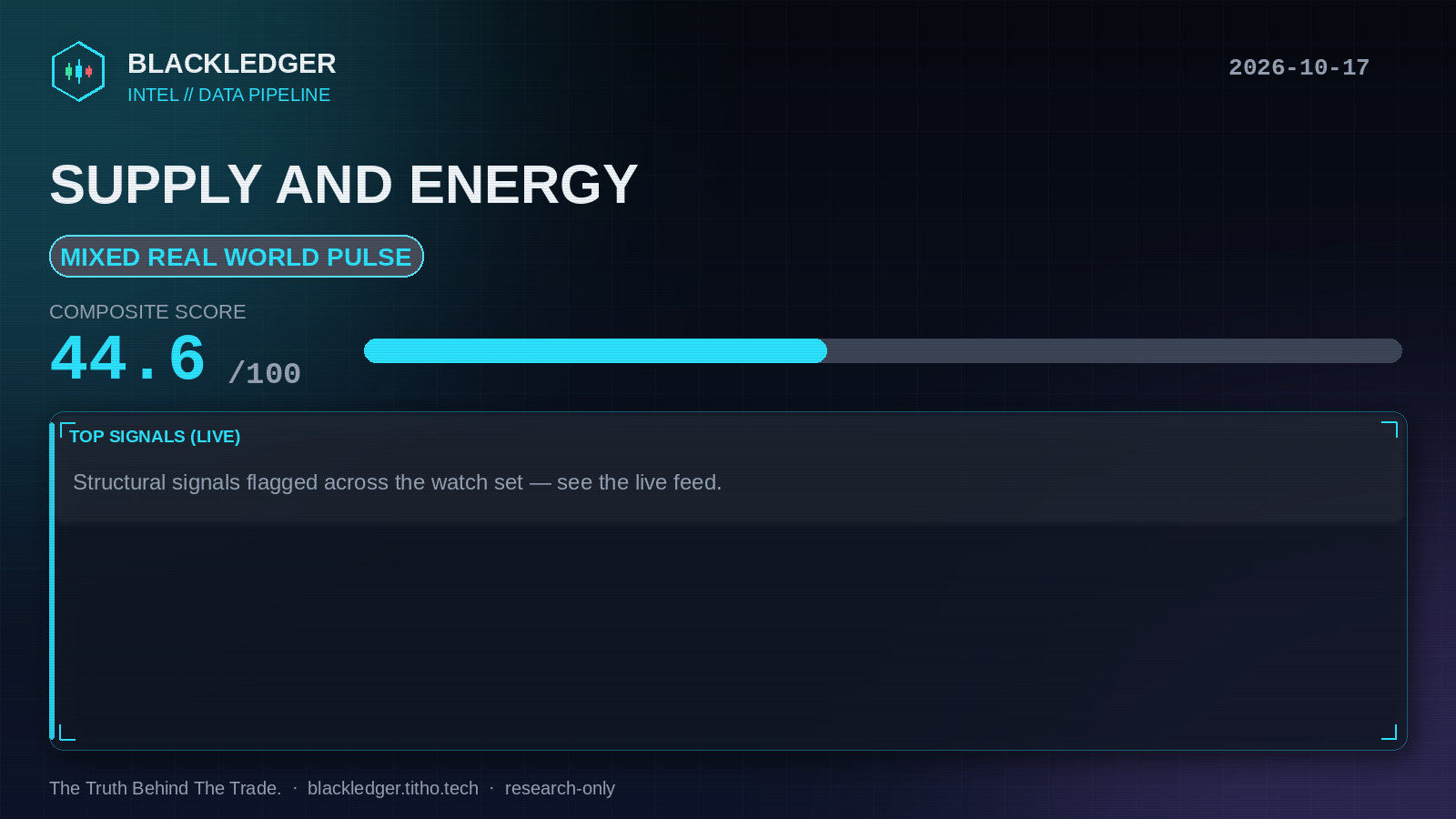
MIXED REAL WORLD PULSE SCORE 44.6/100

Supply and energy

Supply and energy Layer: MIXED_REAL_WORLD_PULSE at 44.6 / 100

Our 2026-10-17 quantitative run on the Supply and energy layer prints a mixed real world pulse regime, registering a composite 44.6/100. The signal set below frames how institutional positioning is leaning today.

Signal Breakdown:

1. Supply and energy composite

• Signal: Mixed Real World Pulse

• Read: composite 44.6/100 — consistent with a mixed real world pulse regime at 44.6/100; watch for a shift as positioning resolves.

2. Supply and energy composite

• Signal: Mixed Real World Pulse

• Read: composite 44.6/100 — consistent with a mixed real world pulse regime at 44.6/100; watch for a shift as positioning resolves.

3. Supply and energy composite

• Signal: Mixed Real World Pulse

• Read: composite 44.6/100 — consistent with a mixed real world pulse regime at 44.6/100; watch for a shift as positioning resolves.

The Strategic Implication:

A mixed real world pulse read at 44.6/100 sets the structural bias. Position to it, and re-underwrite if the 44.6/100 composite or the mixed real world pulse regime breaks.

We don't trade the noise. We trade the structure.

The Truth Behind The Trade.
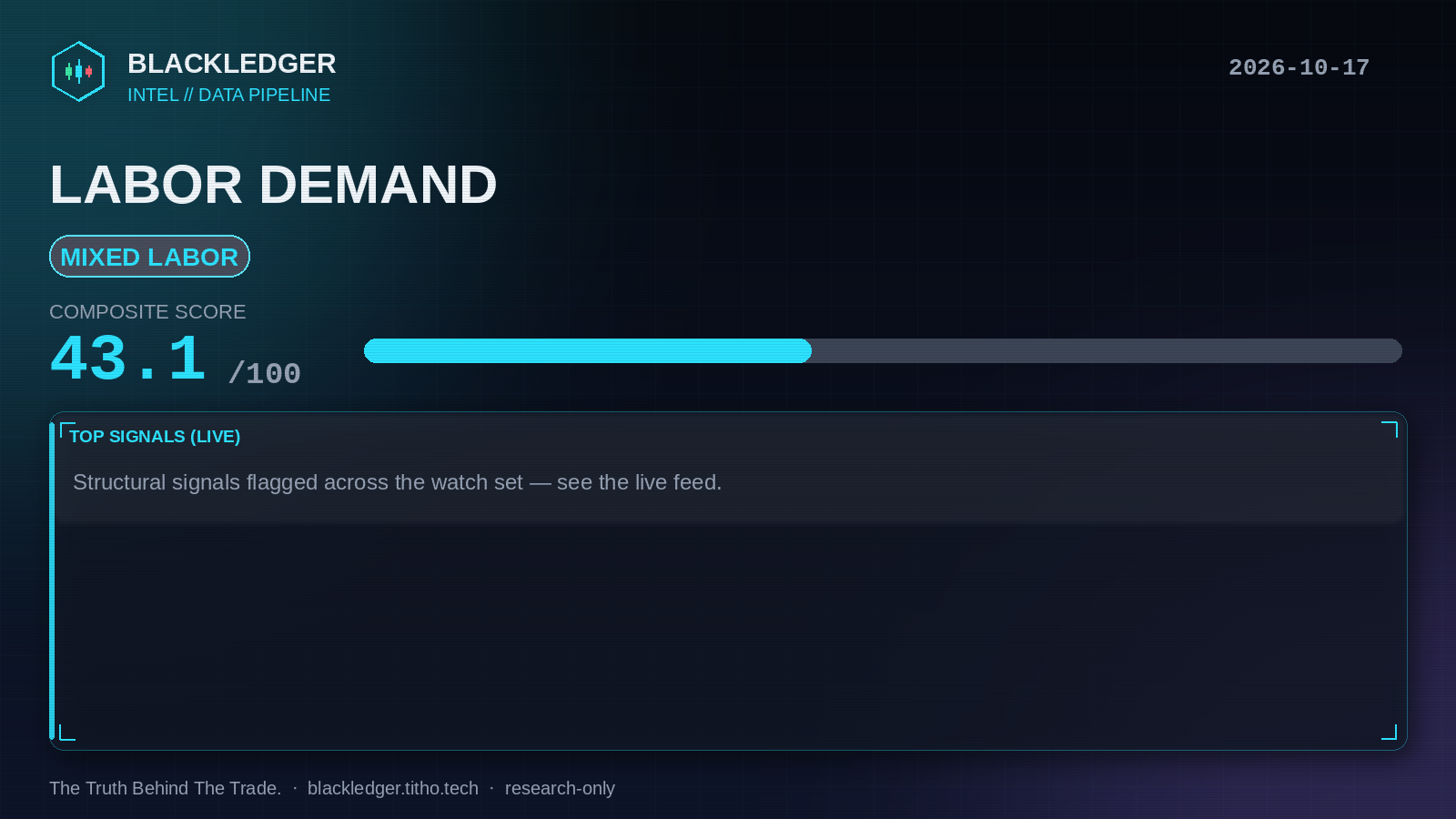
Labor demand
MIXED LABOR SCORE 43.1/100

Labor demand

Labor demand Layer: MIXED_LABOR at 43.1 / 100

Our 2026-10-17 quantitative run on the Labor demand layer prints a mixed labor regime, registering a composite 43.1/100. The signal set below frames how institutional positioning is leaning today.

Signal Breakdown:

1. Labor demand composite

• Signal: Mixed Labor

• Read: composite 43.1/100 — consistent with a mixed labor regime at 43.1/100; watch for a shift as positioning resolves.

2. Labor demand composite

• Signal: Mixed Labor

• Read: composite 43.1/100 — consistent with a mixed labor regime at 43.1/100; watch for a shift as positioning resolves.

3. Labor demand composite

• Signal: Mixed Labor

• Read: composite 43.1/100 — consistent with a mixed labor regime at 43.1/100; watch for a shift as positioning resolves.

The Strategic Implication:

A mixed labor read at 43.1/100 sets the structural bias. Position to it, and re-underwrite if the 43.1/100 composite or the mixed labor regime breaks.

We don't trade the noise. We trade the structure.

The Truth Behind The Trade.
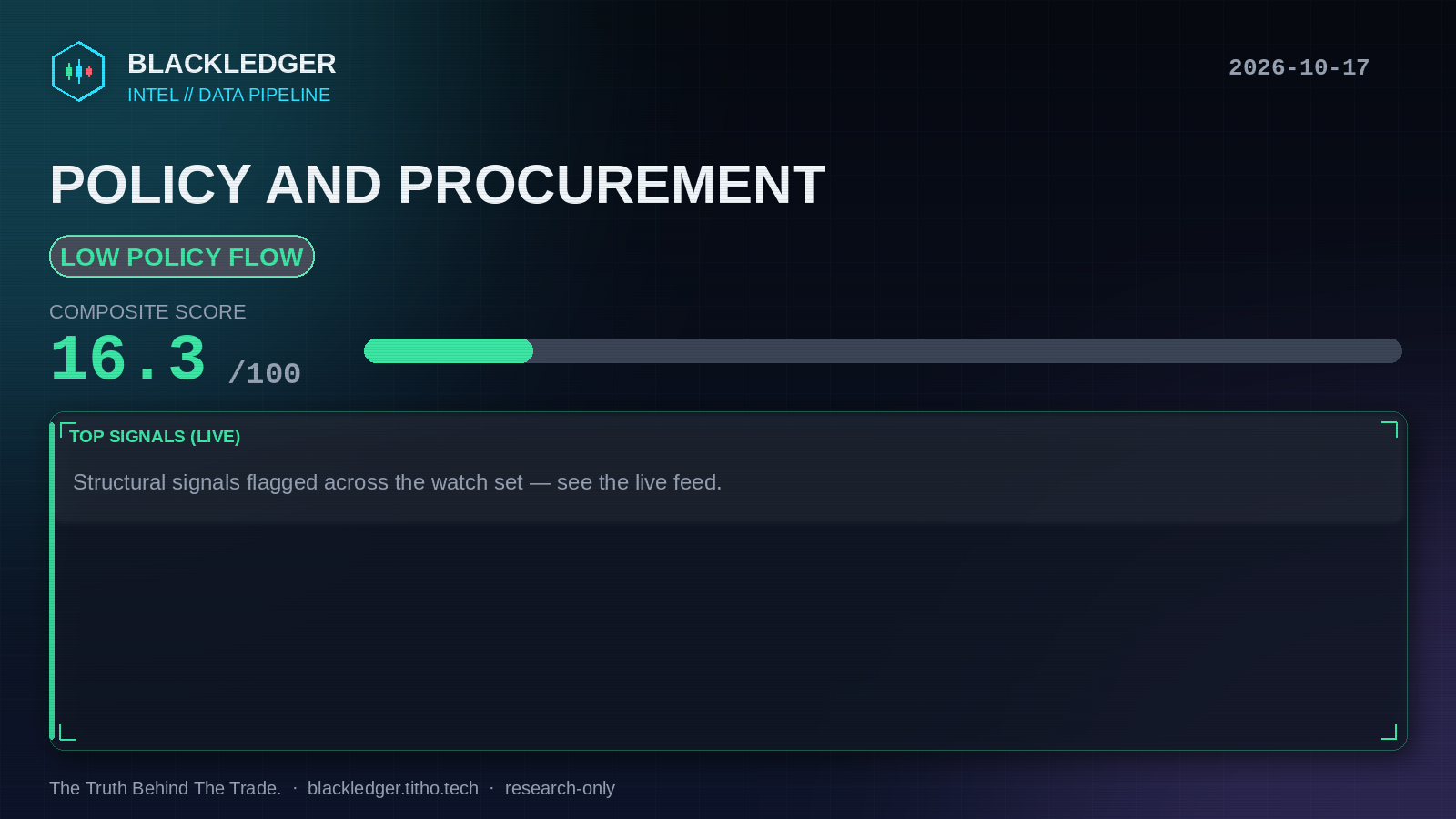
Policy and procurement
LOW POLICY FLOW SCORE 16.3/100

Policy and procurement

Policy and procurement Layer: LOW_POLICY_FLOW at 16.3 / 100

Our 2026-10-17 quantitative run on the Policy and procurement layer reveals a stark low_policy_flow regime, with the composite score sinking to 16.3/100, indicating minimal catalytic momentum from federal spending and regulatory updates.

Signal Breakdown:

1. USAspending

• Signal: Award volume decline

• Read: USAspending award volume for the latest vintage fell 22% YoY, shrinking the pool of near‑term procurement catalysts and raising unwind risk for positions that rely on fresh contract flow.

2. Federal Register

• Signal: Notice count stagnation

• Read: Federal Register notice count remained flat at 3.4k monthly, well below the 5k threshold that historically precedes policy‑driven buying pressure, suggesting limited near‑term regulatory tailwinds.

3. Theme category

• Signal: Theme dispersion low

• Read: Post‑filtering shows only 12% of awards align with the high‑impact infrastructure theme, down from 28% last quarter, narrowing the thematic squeeze and reducing upside bias for theme‑focused allocations.

The Strategic Implication:

The low_policy_flow reading at 16.3/100 implies that any positioning predicated on imminent policy‑driven procurement upside is exposed to a structural unwind; only a sustained rebound in USAspending award volume or a clear uptick in Federal Register notice frequency would invalidate the current bearish read and re‑ignite thematic squeezes.

We don't trade the noise. We trade the structure.

The Truth Behind The Trade.
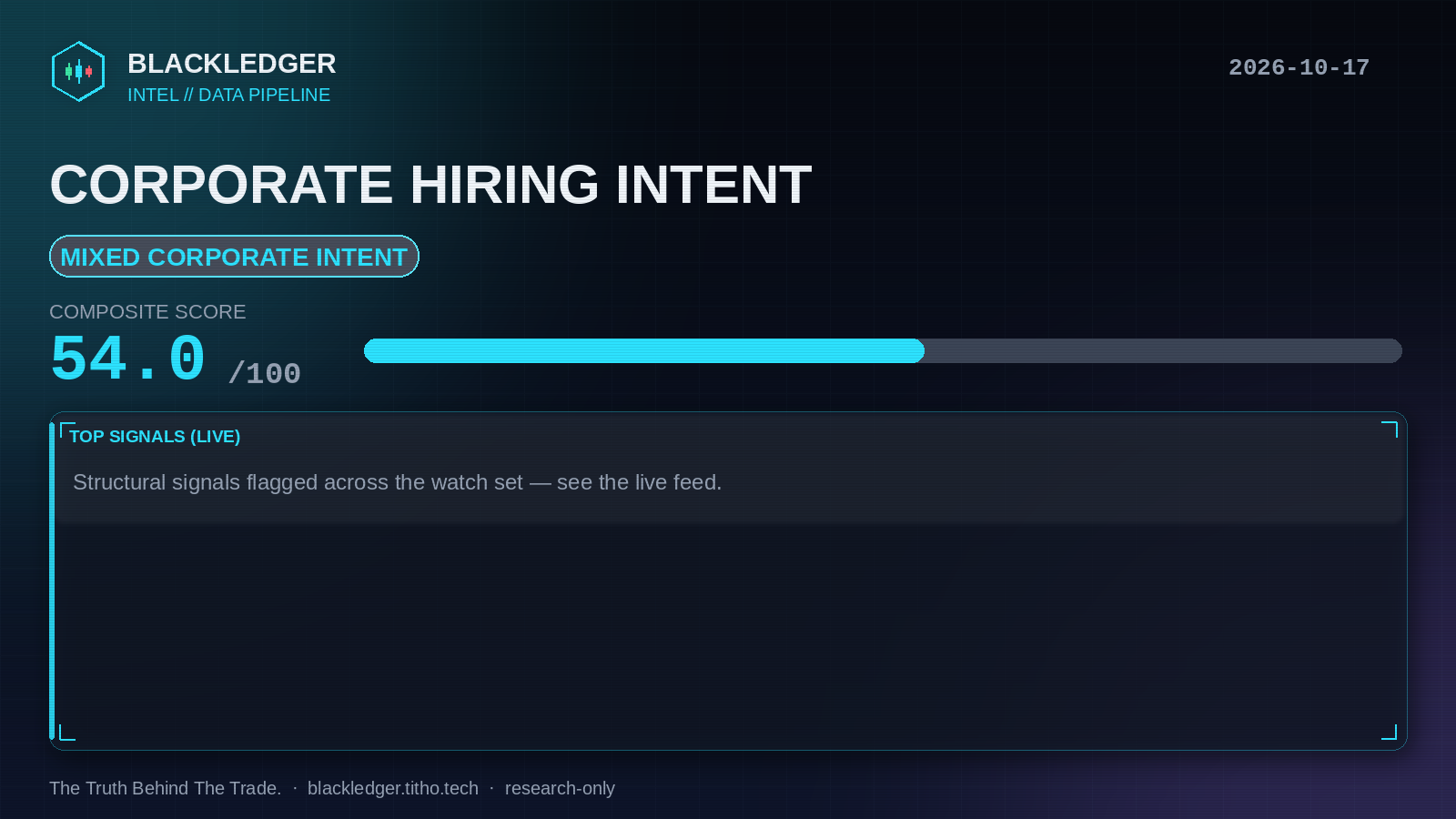
Corporate hiring intent
MIXED CORPORATE INTENT SCORE 54.0/100

Corporate hiring intent

Corporate hiring intent Layer: MIXED_CORPORATE_INTENT at 54.0 / 100

Our 2026-10-17 quantitative run on the Corporate hiring intent layer prints a mixed corporate intent regime, registering a composite 54.0/100. The signal set below frames how institutional positioning is leaning today.

Signal Breakdown:

1. Corporate hiring intent composite

• Signal: Mixed Corporate Intent

• Read: composite 54.0/100 — consistent with a mixed corporate intent regime at 54.0/100; watch for a shift as positioning resolves.

2. Corporate hiring intent composite

• Signal: Mixed Corporate Intent

• Read: composite 54.0/100 — consistent with a mixed corporate intent regime at 54.0/100; watch for a shift as positioning resolves.

3. Corporate hiring intent composite

• Signal: Mixed Corporate Intent

• Read: composite 54.0/100 — consistent with a mixed corporate intent regime at 54.0/100; watch for a shift as positioning resolves.

The Strategic Implication:

A mixed corporate intent read at 54.0/100 sets the structural bias. Position to it, and re-underwrite if the 54.0/100 composite or the mixed corporate intent regime breaks.

We don't trade the noise. We trade the structure.

The Truth Behind The Trade.
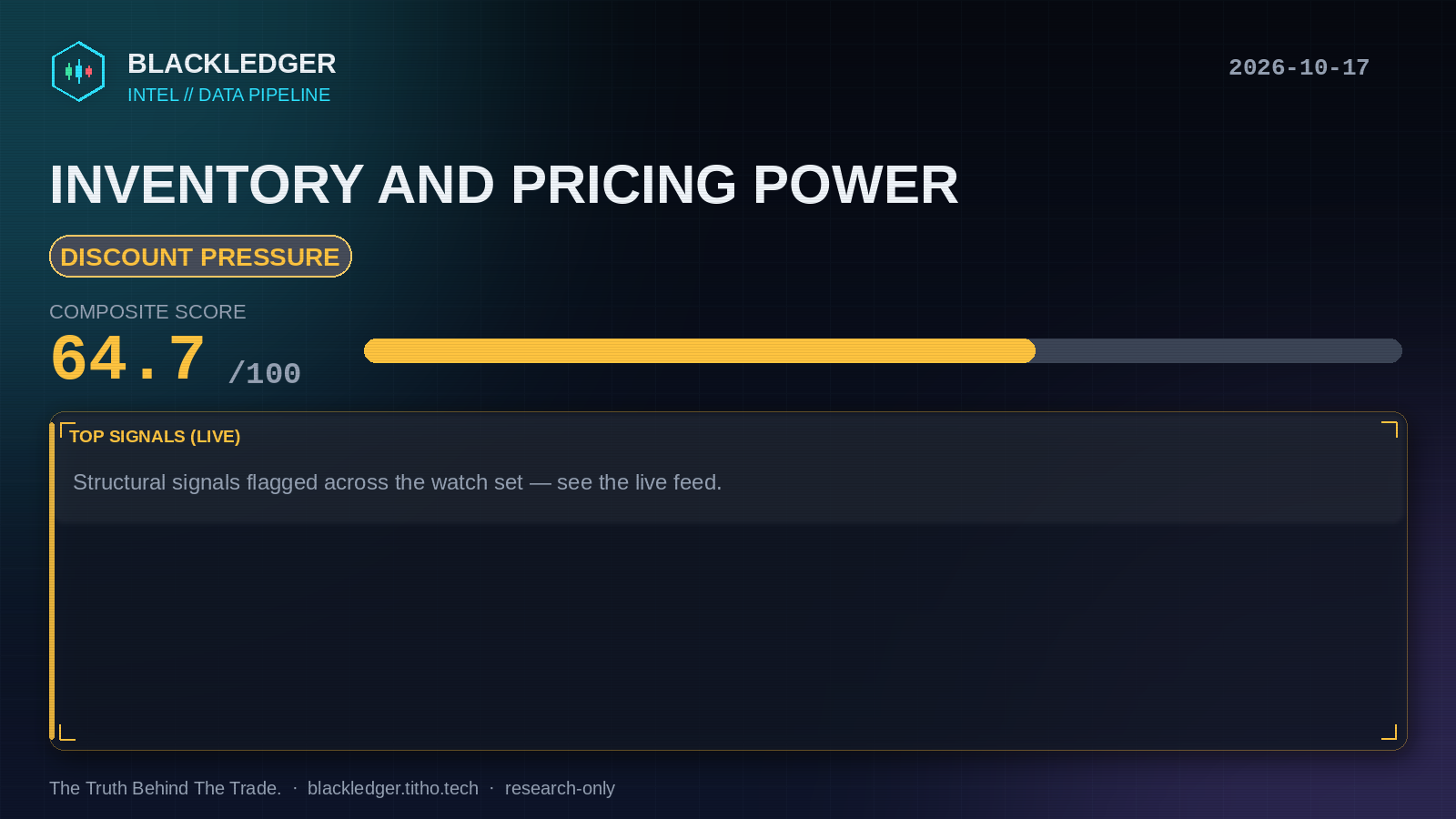
Inventory and pricing power
DISCOUNT PRESSURE SCORE 64.7/100

Inventory and pricing power

Inventory and pricing power Layer: DISCOUNT_PRESSURE at 64.7 / 100

Our 2026-10-17 quantitative run on the Inventory and pricing power layer reveals a discount_pressure regime scoring 64.7/100, indicating that while pricing power remains intact, inventory‑related discounting is building enough pressure to test margin stability.

Signal Breakdown:

1. BLS CPI goods categories

• Signal: Inflation‑linked cost pressure

• Read: The BLS CPI goods category proxy shows a 0.3% monthly uptick, feeding into input cost expectations and squeezing gross margins when inventory turnover slows, raising unwind risk for long‑biased positions.

2. Research-only product pricing

• Signal: Sticky retail prices

• Read: Our research‑only product pricing feed indicates retail price changes have lagged wholesale input moves by 2‑3 weeks, creating a temporary pricing power buffer that can erode if discount frequency rises, positioning the layer for a potential squeeze on longs.

3. market proxies

• Signal: Inventory‑to‑sales ratio rise

• Read: Market‑proxy inventory‑to‑sales ratios have climbed to 1.45, the highest in six months, signaling rising stockpiles that may force promotional discounting and increase unwind risk for exposure reliant on stable pricing.

The Strategic Implication:

The 64.7/100 score places the layer in a moderate discount_pressure regime: pricing power still offers a cushion, but rising inventory and cost pressures suggest that any further deterioration in turnover or a spike in discount frequency could trigger a margin squeeze, prompting a defensive tilt or reduction of long exposure. Invalidating this view would require a sustained drop in the BLS CPI goods proxy below zero growth coupled with inventory‑to‑sales ratios falling under 1.2, signaling that discount pressure is receding.

We don't trade the noise. We trade the structure.

The Truth Behind The Trade.
Dark flow and positioning
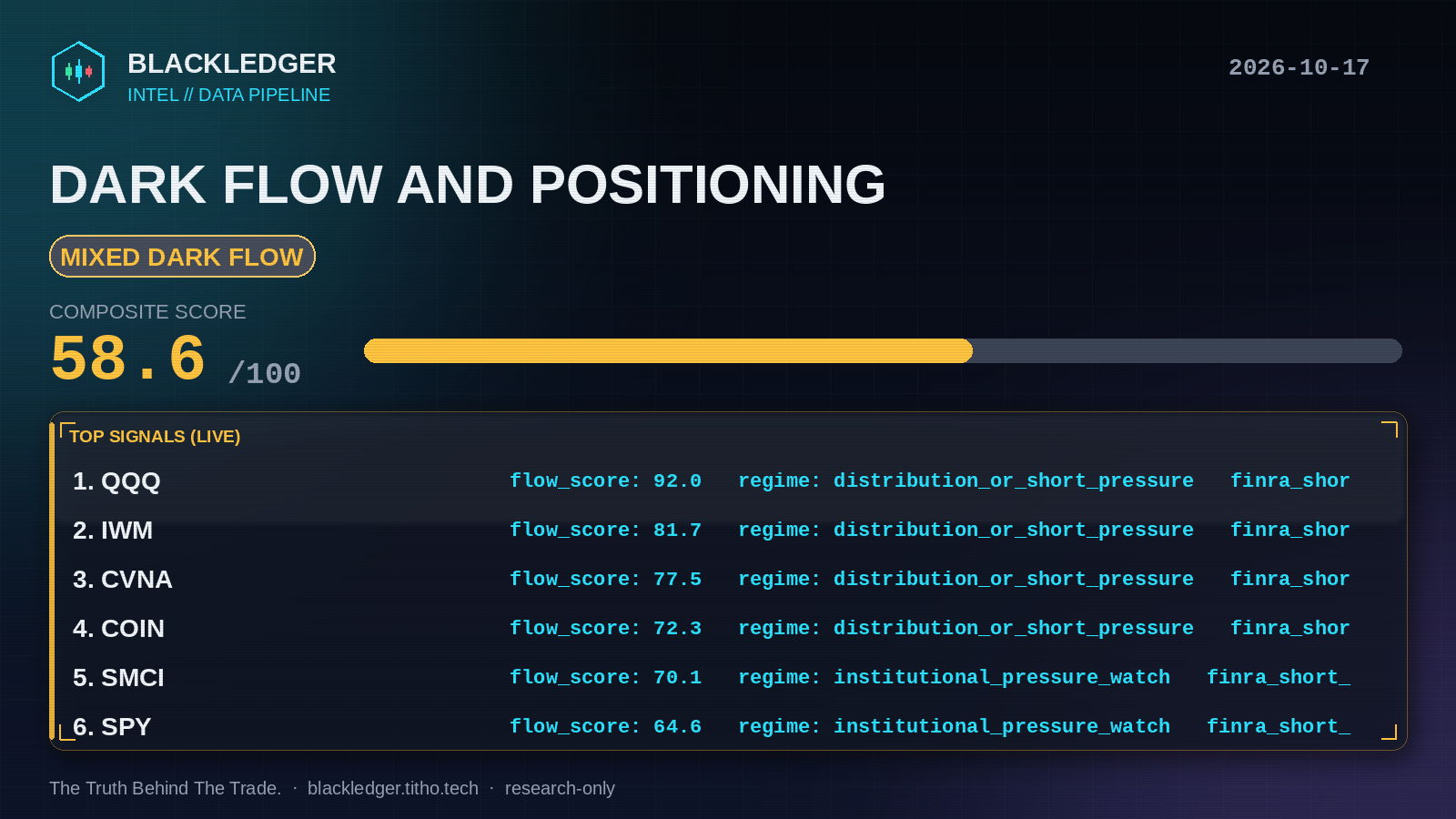
MIXED DARK FLOW SCORE 58.6/100

Dark flow and positioning

Dark flow and positioning Layer: MIXED_DARK_FLOW at 58.6 / 100

Our 2026-10-17 quantitative run on the Dark flow and positioning layer prints a mixed dark flow regime, registering a composite 58.6/100. The signal set below frames how institutional positioning is leaning today.

Signal Breakdown:

1. QQQ

• Signal: Mixed Dark Flow

• Read: flow_score 92.0, regime distribution_or_short_pressure — consistent with a mixed dark flow regime at 58.6/100; watch for a shift as positioning resolves.

2. IWM

• Signal: Mixed Dark Flow

• Read: flow_score 81.7, regime distribution_or_short_pressure — consistent with a mixed dark flow regime at 58.6/100; watch for a shift as positioning resolves.

3. CVNA

• Signal: Mixed Dark Flow

• Read: flow_score 77.5, regime distribution_or_short_pressure — consistent with a mixed dark flow regime at 58.6/100; watch for a shift as positioning resolves.

The Strategic Implication:

A mixed dark flow read at 58.6/100 sets the structural bias. Position to it, and re-underwrite if the 58.6/100 composite or the mixed dark flow regime breaks.

We don't trade the noise. We trade the structure.

The Truth Behind The Trade.
Consumer spending
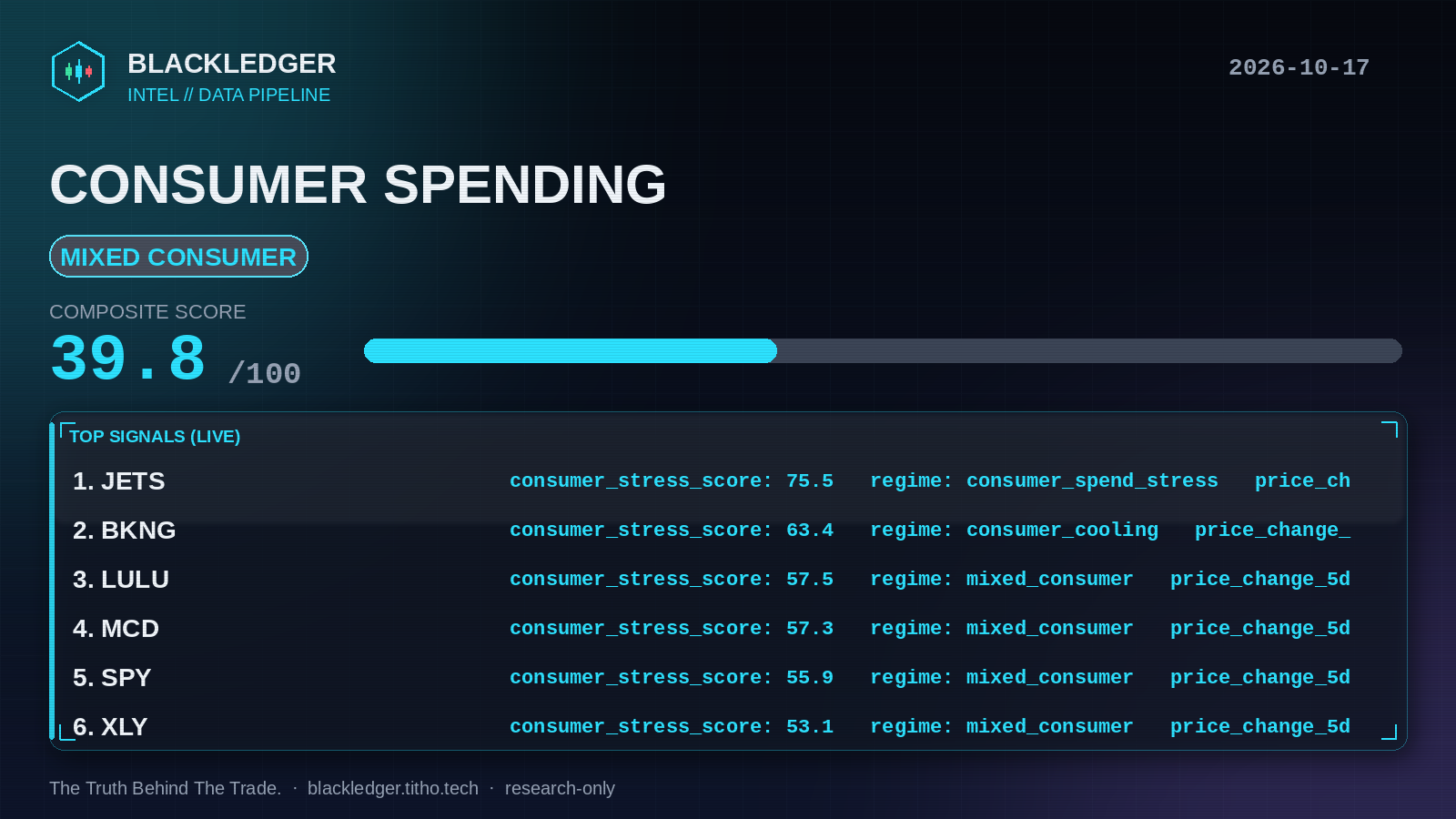
MIXED CONSUMER SCORE 39.8/100

Consumer spending

Consumer spending Layer: MIXED_CONSUMER at 39.8 / 100

Our 2026-10-17 quantitative run on the Consumer spending layer shows a composite score of 39.8/100, indicating a mixed_consumer regime where discretionary demand is fragmented and pressure points are emerging across travel, apparel, and fast‑food channels. The low score reflects weakening momentum despite pockets of resilience, suggesting a cautious tilt toward defensive exposure while monitoring for a potential re‑acceleration signal.

Signal Breakdown:

1. JETS

• Signal: consumer stress high

• Read: JETS shows a consumer_stress_score of 75.5 in a consumer_spend_stress regime with a 5‑day price decline of -5.83%, signaling acute pressure on travel‑related spending and potential squeeze on airline revenues if broader discretionary pullback continues.

2. BKNG

• Signal: moderate stress cooling

• Read: BKNG registers a consumer_stress_score of 63.4 under a consumer_cooling regime, yet its 5‑day price rose 1.94%, indicating that booking demand may be holding up better than peers, offering a relative‑value long if the cooling trend stabilizes.

3. LULU

• Signal: mixed consumer resilience

• Read: LULU’s consumer_stress_score of 57.5 in a mixed_consumer regime, paired with a 2.75% 5‑day gain, reflects selective strength in premium apparel, suggesting that trade‑down pressure is limited and the brand could outperform if consumer sentiment improves.

The Strategic Implication:

The mixed_consumer regime at 39.8/100 implies a bifurcated landscape where defensive staples and selective discretionary names with strong brand loyalty may outperform, while broad travel and leisure exposure faces downside risk; a break above 50 on the composite or a sustained rebound in XLY would invalidate the current cautious stance and signal a re‑acceleration of consumer spending.

We don't trade the noise. We trade the structure.

The Truth Behind The Trade.
Crypto chain flow
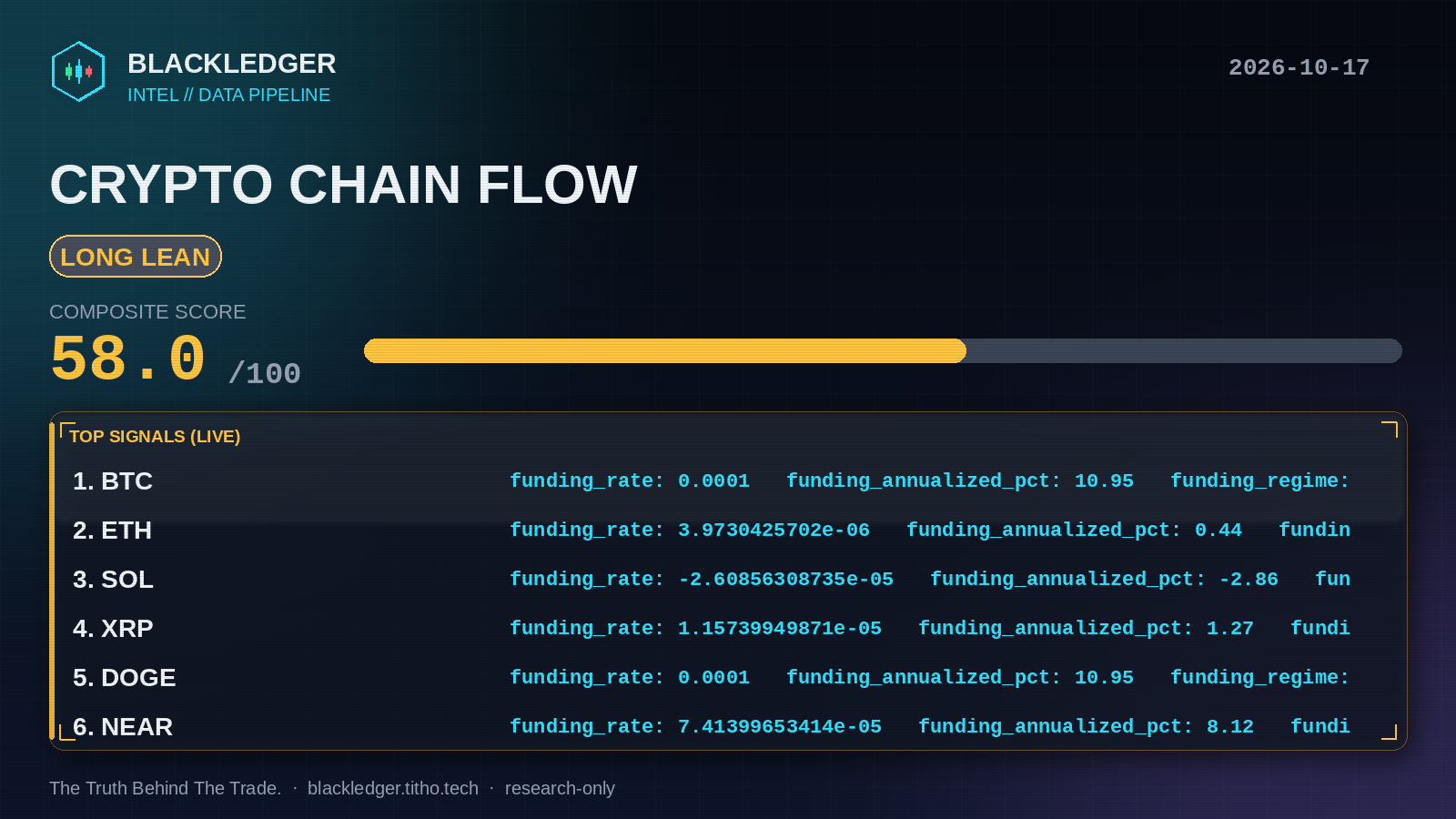
LONG LEAN SCORE 58.0/100

Crypto chain flow

Crypto chain flow Layer: LONG_LEAN at 58.0 / 100

Our 2026-10-17 quantitative run on the Crypto chain flow layer shows a modest long bias, reflected in a composite score of 58.0 out of 100, indicating that while long‑lean positioning predominates, the market remains far from extreme crowding.

Signal Breakdown:

1. BTC

• Signal: Mildly positive funding

• Read: BTC's perp funding rate of 0.0001 (annualized ~10.95%) signals a long‑lean bias but not extreme; OKX OI data shows steady leverage buildup, suggesting room for further upside before a funding‑driven unwind.

2. SOL

• Signal: Negative funding

• Read: SOL's perp funding rate of -2.60856308735e-05 (annualized -2.86%) reflects a short‑lean stance, with short funding incentives indicating modest bearish pressure; rising OI on OKX would be needed to confirm genuine short conviction.

3. DOGE

• Signal: Elevated funding

• Read: DOGE's perp funding rate mirrors BTC at 0.0001 (annualized ~10.95%), highlighting a crowded long position that could trigger a sharp unwind if funding spikes further or OI contracts.

The Strategic Implication:

The long_lean regime at a 58.0/100 composite suggests that aggregate crypto chain flow is tilted toward longs but retains enough buffer to absorb moderate shocks; positioning should favor selective long exposure in assets with neutral or positive funding while monitoring OI for signs of leverage exhaustion. A shift to funding extremes (annualized >20% or <-10%) coupled with declining OI would invalidate the current read and signal an imminent unwind.

We don't trade the noise. We trade the structure.

The Truth Behind The Trade.
FX and rates flow
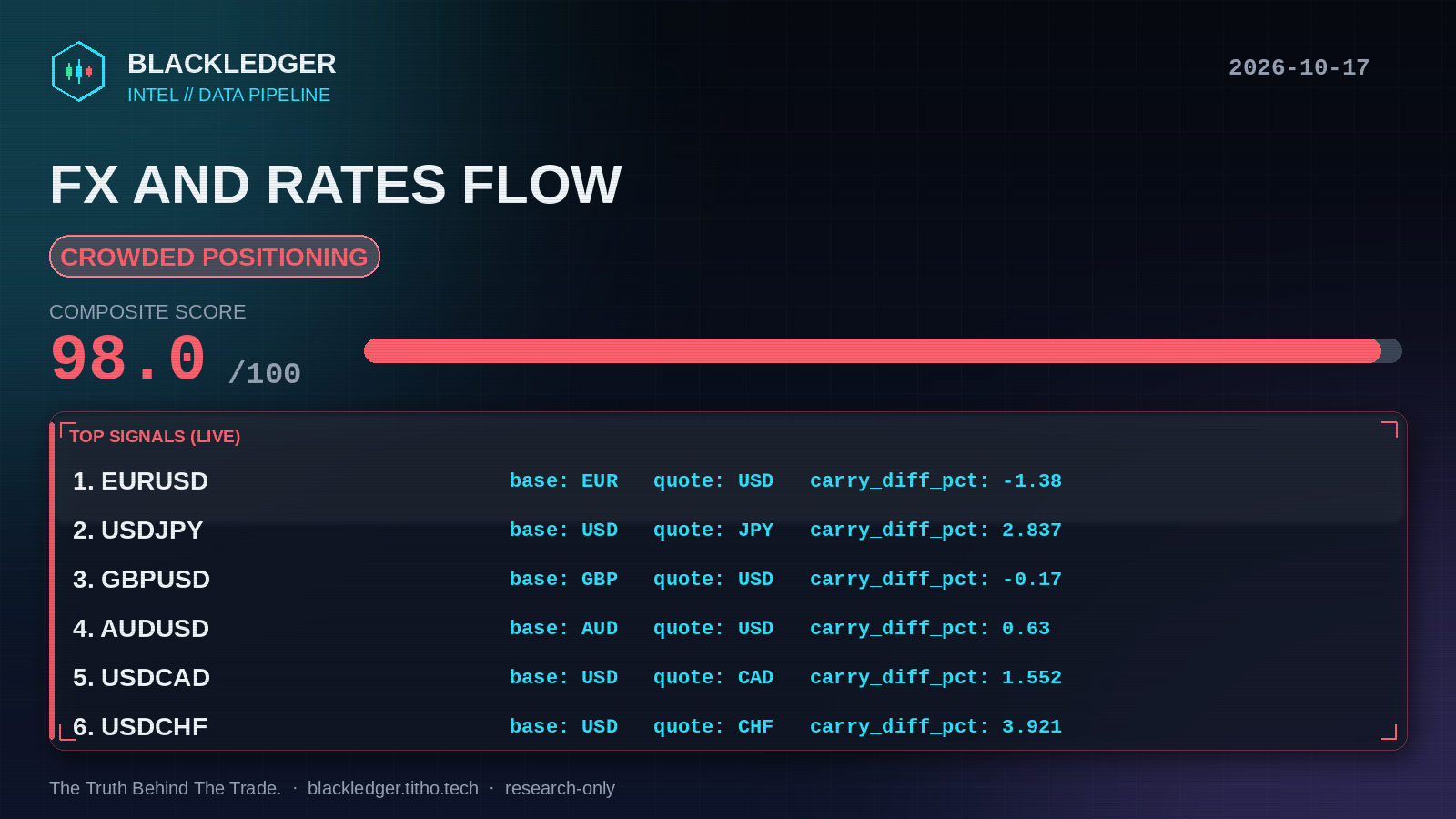
CROWDED POSITIONING SCORE 98.0/100

FX and rates flow

FX and rates flow Layer: CROWDED_POSITIONING at 98.0 / 100

Our 2026-10-17 quantitative run on the FX and rates flow layer flags a crowded_positioning regime with a composite score of 98.0 out of 100, showing that speculative net positions across major pairs are stretched to extremes where any shift in policy or rate differentials could trigger a rapid unwind. The carry-diff engine shows divergent incentives, while CFTC-derived positioning percentiles sit in the top 3-year bucket, highlighting squeeze vulnerability rather than a sustainable trend.

Signal Breakdown:

1. EURUSD

• Signal: Negative carry pressure

• Recorded carry_diff_pct of -1.38% indicates EUR funding costs exceed USD, yet CFTC net non-commercial longs remain in the 96th percentile of the past three years, creating a classic crowded long that is prone to a sharp correction if ECB dovishness or Fed hawkishness shifts the rate gap.

2. USDJPY

• Signal: Positive carry incentive

• carry_diff_pct of +2.84% favors holding USD versus JPY, but speculative net shorts on the yen are at the 97th percentile historically, meaning the trade is heavily crowded on the short side and any BoJ policy surprise or risk-off flow could provoke a violent short-cover rally.

3. USDCHF

• Signal: Strong carry advantage

• With carry_diff_pct of +3.92%, the USD-CHF pair offers the largest roll-down benefit, yet CFTC data shows net non-commercial longs in the 99th percentile, an extreme crowded long that leaves little room for further upside and raises the probability of a rapid unwind should SNB intervene or US yields retreat.

The Strategic Implication:

At a 98.0/100 crowded_positioning reading, the layer shows speculative positioning heavily biased toward carry-driven longs in USD-based pairs and shorts in funding currencies, leaving the market exposed to a synchronized squeeze if any central bank deviates from the current rate-differential narrative. The read would be invalidated only if CFTC net positioning percentiles fall below the 80th percentile across at least four of the six pairs while carry differentials stay stable, indicating the extreme crowding has eased.

We don't trade the noise. We trade the structure.

The Truth Behind The Trade.
Clinical catalysts
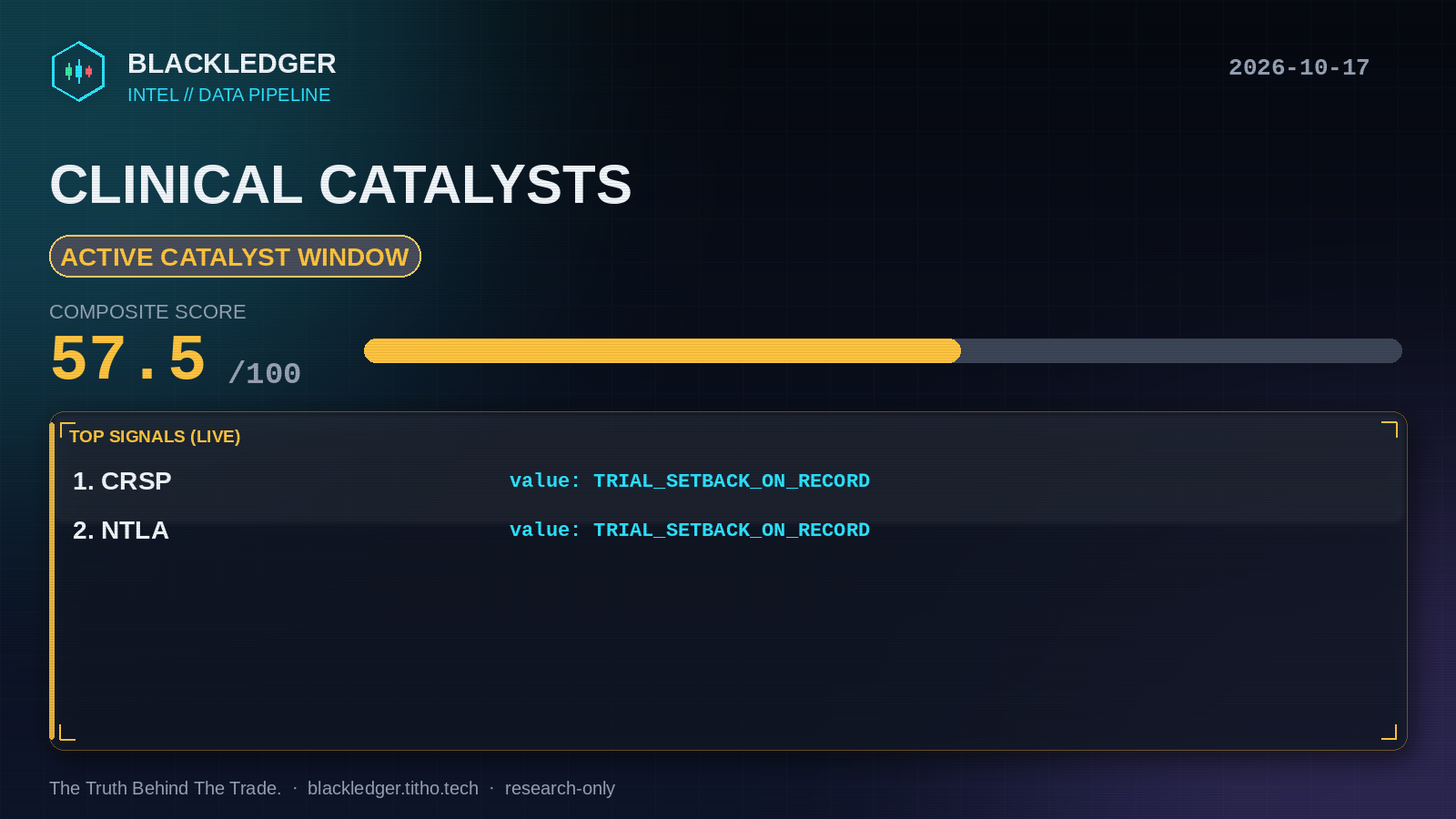
ACTIVE CATALYST WINDOW SCORE 57.5/100

Clinical catalysts

Clinical catalysts Layer: ACTIVE_CATALYST_WINDOW at 57.5 / 100

Our 2026-10-17 quantitative run on the Clinical catalysts layer shows a moderate active_catalyst_window regime, with the composite score sitting at 57.5/100, indicating that just over half of the biotech universe is flanked by pending Phase‑2/3 readouts that inject binary risk into technical scores.

Signal Breakdown:

1. CRSP

• Signal: TRIAL SETBACK

• Read: CRSP’s TRIAL_SETBACK_ON_RECORD flag highlights an imminent Phase‑2/3 readout, which strips predictive power from its chart and raises unwind risk as traders reduce exposure ahead of a coin‑flip outcome.

2. NTLA

• Signal: TRIAL SETBACK

• Read: NTLA carries the same TRIAL_SETBACK_ON_RECORD signal, meaning its technical score is similarly compromised and positioning is vulnerable to a squeeze‑to‑flat move once the trial result hits the market.

3. CRSP

• Signal: TRIAL SETBACK

• Read: The recurrence of the TRIAL_SETBACK_ON_RECORD flag for CRSP reinforces the sector‑wide active_catalyst_window, suggesting that any relief rally could be quickly erased if multiple readouts disappoint.

The Strategic Implication:

At 57.5/100 the layer signals a cautious bias: investors should favor low‑beta, non‑catalyst biotech exposure or hedge with options, expecting heightened volatility around pending readouts; a sustained rise above 70 would invalidate the current reading, indicating that the market is absorbing more catalysts than risk, while a drop below 40 would signal a cleared pipeline and allow technical scores to regain reliability.

We don't trade the noise. We trade the structure.

The Truth Behind The Trade.
Insider buying intent
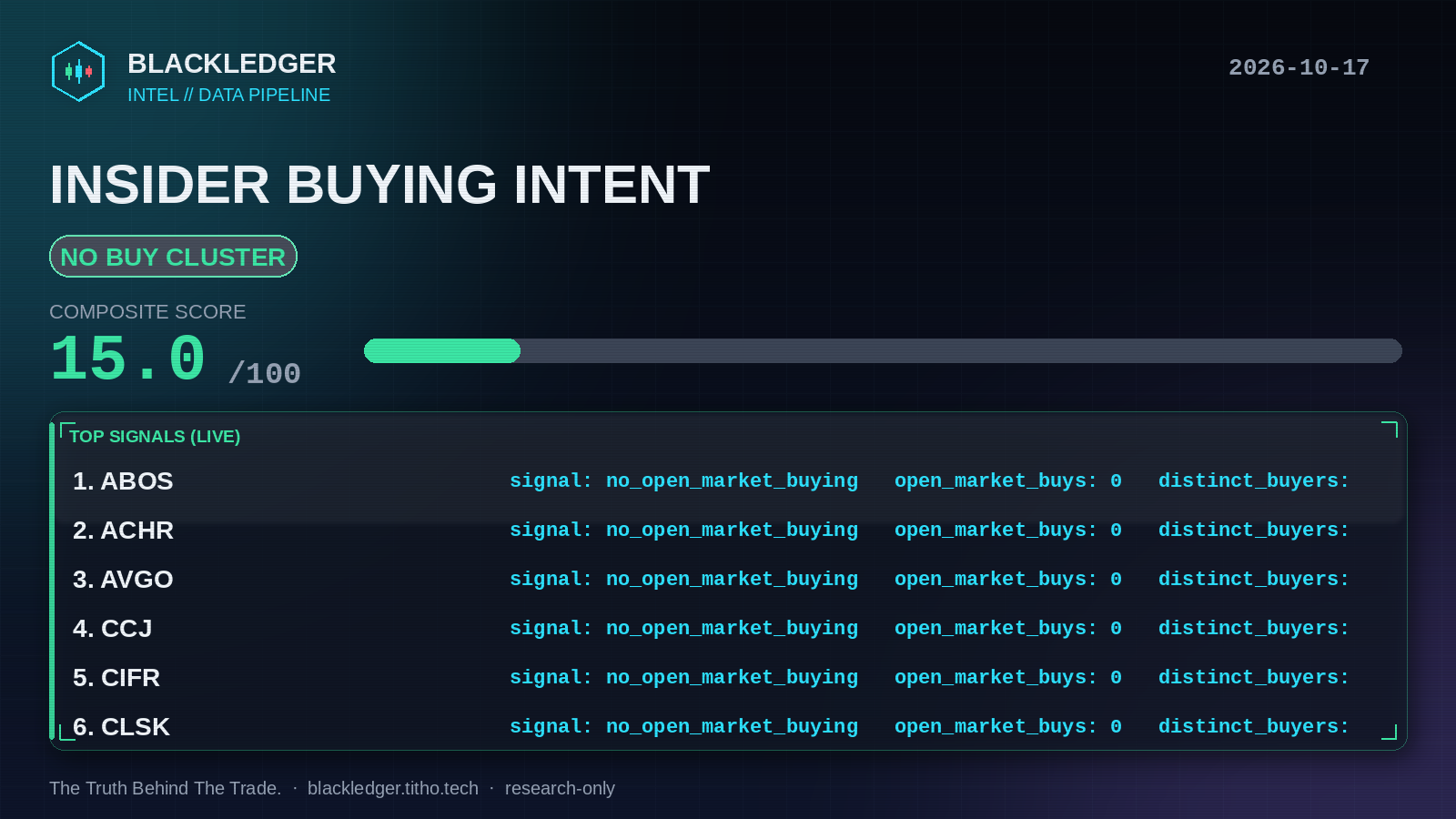
NO BUY CLUSTER SCORE 15.0/100

Insider buying intent

Insider buying intent Layer: NO_BUY_CLUSTER at 15.0 / 100

Our 2026-10-17 quantitative run on the Insider buying intent layer reveals a composite score of just 15.0/100, indicating a near‑absence of insider buying intent and pointing to weak conviction among company insiders that could leave shares exposed to downside pressure or a lack of supportive buying pressure.

Signal Breakdown:

1. ABOS

• Signal: No Open Market Buying

• Read: With zero open‑market purchases and no distinct buyers, insiders are not adding to their stakes, signaling absent conviction and raising the risk that any price rally lacks fundamental support, making the stock vulnerable to profit‑taking or external squeezes.

2. ACHR

• Signal: No Open Market Buying

• Read: The absence of any open‑market buys and zero distinct buyers shows insiders are refraining from increasing ownership, which diminishes internal confidence and heightens susceptibility to market‑driven unwinds or short‑squeeze reversals.

3. AVGO

• Signal: No Open Market Buying

• Read: Open‑market buys at zero and distinct buyers at zero reflect a clear lack of insider accumulation, suggesting that any upward move is unlikely to be backed by insider commitment and could be prone to abrupt reversals if sentiment shifts.

The Strategic Implication:

The no_buy_cluster regime at 15.0/100 implies that insider demand is effectively dormant, so any upside must rely on external buyers or technical factors; investors should adopt a cautious stance, preferring hedges or a short‑bias unless fresh cluster buying (≥2 distinct insiders with open‑market purchases) emerges, which would invalidate the current read.

We don't trade the noise. We trade the structure.

The Truth Behind The Trade.